
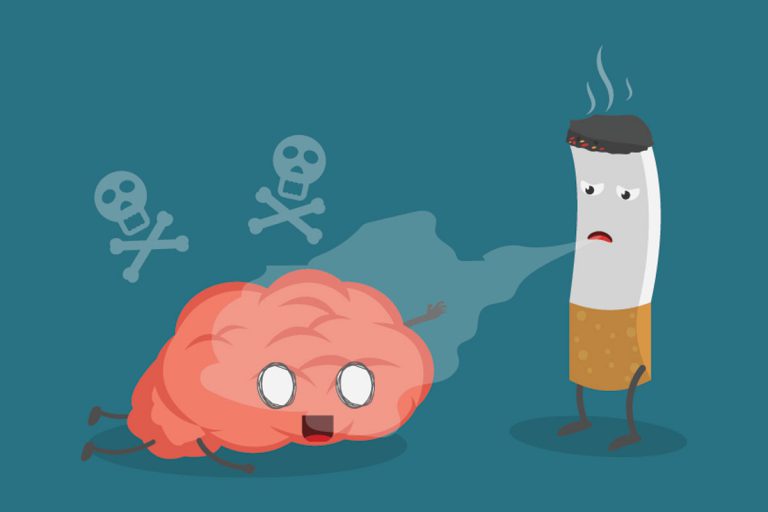
Smoking damages the brain. In the Whitehall II study of more than 10,000 middle-aged adults, smokers had a greater risk of poor memory and a 37% higher risk of cognitive decline, and a meta-analysis of over 26,000 elderly people tied current smoking to a 40%-80% higher risk of dementia and cognitive decline.
If you thought the only dangers of smoking were chronic obstructive pulmonary disease (COPD), emphysema and lung cancer, think again. New studies now link the expensive (financially and health-wise) habit with new concerns. One recent paper, “Smoking History and Cognitive Function in Middle Age From the Whitehall II Study,” appeared in the Archives of Internal Medicine. Head investigator, Séverine Sabia, MSc—from the Institut National de la Santé et de la Recherche Médicale in Villejuif, France—looked at recent discussions linking smoking with dementia, considered related through the effect smoking has on vascular disease. The Whitehall II study evaluated over 10,000 participants, aged 35-55 (at baseline, phase 1, 1985-1988). Assessments were made on smoking history at both phase 1 and phase 5 (1997-1999). Among the group, 25% were light smokers (≤ 5 cigarettes per day) and 25% were heavy smokers (1-2 packs per day). Smokers had an average of 14 cigarettes daily; only 27 participants smoked over two packs a day. Cognitive data (memory, reasoning, vocabulary and semantic/phonemic fluency) were available for 5,388 study subjects at phase 5—when participants were 45-68 years old/mean age 55.5. Of those, 4,659 were retested 5 years later for phase 7, when study subjects were 50-74 years old/mean age 61. • Smoking was associated with greater risk of poor memory. • After adjustments at phase 5, smokers had a 37% higher risk for cognitive decline. • Long-term ex-smokers (stopped prior to study) demonstrated a 30% lower risk for poor cognition (vocabulary decline and reduced verbal fluency)—possibly due to health behavior improvements. • Positive midlife health changes (better nutrition, exercise, alcohol consumption, etc.) and smoking cessation were linked. • Middle-aged smokers are more likely to be lost to follow-up by death or through nonparticipation in cognitive tests. Therefore, the smoking–cognitive decline link could be undervalued. • Additional research indicates that mild cognitive decline continues at an accelerated rate to clinically diagnosed dementia. • A 2007 meta-analysis of 19 studies of over 26,000 elderly (mean age 74) demonstrated that current smoking increased risk for dementia and cognitive decline by 40%-80%, depending upon measure employed. • A ten-year study of over 3,600 Australians demonstrated that smokers had a four-fold increased risk of age-related macular degeneration compared to non-smokers. • A June 2008 study showed that smokers have higher all-cause mortality, equivalent to a non-smoker 5-10 years older. The excuse of weight gain: One objection smokers often give for not quitting is weight gain. That may be true for light smokers (less than one pack per day), but heavy smokers (greater than one pack per day) tend to have other associated health habits, such as weighing more and having an increased risk for metabolic syndrome and diabetes. The bottom line: Smoking shows no benefits on any level. Smoking is counterproductive to healthy aging. You can stay active, alert, lean and healthy with established protocols, shown to improve cognitive function and physical/sexual energy as well as enhance libido and body composition (lean muscle mass, reduced body fat), strengthen your immune system and ability to manage stress.
Frequently asked questions
Does smoking lower your IQ?
The Whitehall II study did not measure IQ. It tested memory, reasoning, vocabulary and verbal fluency in more than 5,000 middle-aged adults, and smokers had a greater risk of poor memory and a 37% higher risk of cognitive decline. Because smokers were more likely to die or drop out before testing, the true link between smoking and mental decline may be even larger.
Will my brain go back to normal after quitting smoking?
Quitting helps. In the Whitehall II study, long-term ex-smokers who stopped before the study began had a 30% lower risk of poor cognition, measured as vocabulary decline and reduced verbal fluency. Quitting also traveled with other healthy midlife changes, such as better nutrition, more exercise and less alcohol. Smoking shows no benefit on any level.
What are the effects of smoking?
Beyond COPD, emphysema and lung cancer, smoking harms the brain and eyes and shortens life. Current smoking raises the risk of dementia and cognitive decline by 40% to 80%. Smokers had four times the risk of age-related macular degeneration in a ten-year Australian study, and a smoker’s death rate matches that of a nonsmoker 5 to 10 years older. Heavy smokers also carry more metabolic syndrome and diabetes risk.